


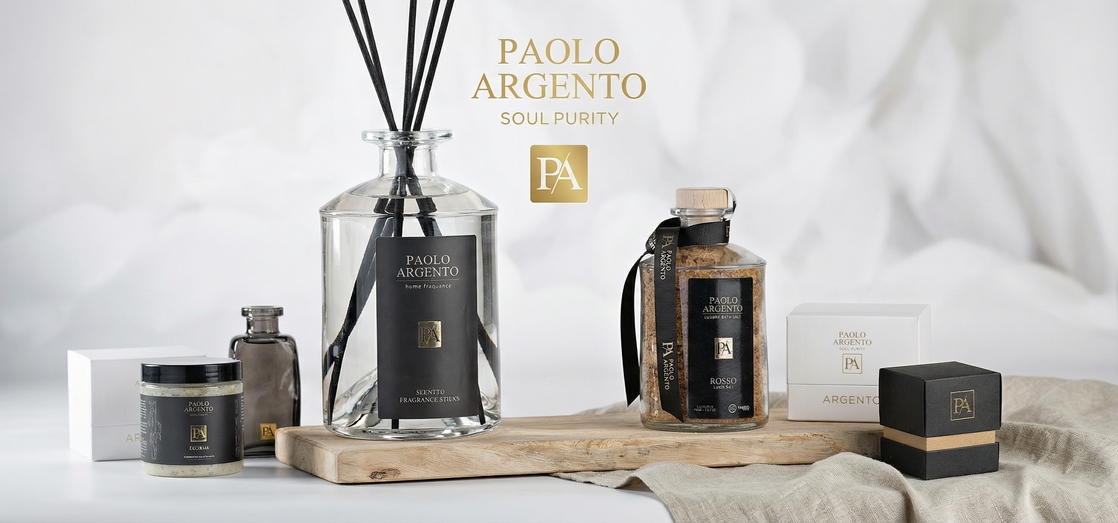
White, pink, yellow, green and even almost black. Cosmetic clays can surprise us with their colours, yet their appearance is not simply decorative. Behind every shade lies the origin of the raw material, its mineral composition and its characteristic properties.
Clays have been used in skincare for a very long time. They can be found in masks, cleansing products, body cosmetics and bath preparations. In Paolo Argento® Salt Bath Elixirs, clay is one element of a more complex formulation alongside mineral salts, plant oils, fragrance compositions and selected botanical additions.
But what exactly is cosmetic clay? Why is one white, another pink and another almost black? And does colour really tell us something about its properties?
What exactly is cosmetic clay?
Clays are natural mineral materials containing very fine clay minerals. They are formed in nature through long geological processes, including the alteration and weathering of rocks.
Their exact composition depends on their origin and the conditions in which they formed. Different clays may contain various clay minerals, iron compounds and other mineral components. These differences influence colour, structure and surface properties.
There is therefore no single universal material called “cosmetic clay”. The term covers an entire group of mineral raw materials with different characteristics.
Where does the colour of clay come from?
The colour of natural clay does not necessarily come from an added pigment. It is primarily connected with mineral composition, naturally occurring compounds and the geological history of the deposit.
Iron compounds are particularly interesting. Depending on their form, concentration and chemical environment, they can contribute yellow, red or brown shades. Pale clays, meanwhile, contain fewer strongly colouring components.
Colour can therefore provide a clue to the character of a raw material, but it should not be treated as a simple measure of quality or strength. Two clays of a similar colour can differ in their precise composition and properties.
White clay – light and gentle
One of the best-known cosmetic clays is kaolin, often referred to as white clay. Its pale colour is associated with its mineral character and the relatively low amount of strongly colouring impurities.
Kaolin is valued in cosmetics partly for its adsorptive properties. Its fine particles can bind certain substances on their surface, which is why it is often used in cleansing and skincare formulations.
White clay is also used in Paolo Argento® BIANCO Salt Bath Elixir, where it is combined with Dead Sea salt, sweet almond oil and botanical additions. Its pale mineral character also complements the visual identity of the composition.
Pink clay – where does its subtle colour come from?
Pink clays owe their colour to their mineral composition and naturally colouring mineral components. In cosmetics, they are appreciated for their subtle appearance and the surface properties typical of fine clay materials.
Pink clay can be found in Paolo Argento® ROSSO Salt Bath Elixir. Its formulation also includes mineral salts, argan oil, vitamin E and botanical additions. The product is completed by a fragrance composition featuring orchid, lily of the valley, musk, vanilla and ylang-ylang.
In such a product, clay does not work alone. It is one part of a broader formulation in which individual ingredients have different roles.
Yellow clay – colour written in minerals
Yellow and golden shades in natural clay materials can be associated with iron compounds. This is a good example of how the colour of clay can be part of its mineral character rather than simply an aesthetic feature of the finished cosmetic.
Yellow clay is an ingredient in Paolo Argento® RAME Salt Bath Elixir. It is accompanied by mineral salts, jojoba oil and lavender, while the fragrance composition includes lavender, geranium, floral notes and musk.
Black clay – visually the most distinctive
Dark clays are among the most visually distinctive. Their colour is connected with the composition of the particular raw material and naturally occurring components responsible for its dark appearance.
Black clay is used in Paolo Argento® NERO Salt Bath Elixir. Its formulation also includes Dead Sea salt and sweet almond oil, while the NERO fragrance brings notes including lemon, bergamot, sandalwood, vanilla, vetiver, amber and patchouli.
The dark clay also influences the visual character of the product, making a bath with this Elixir look different from one prepared with a traditional pale bath salt.
And what about green clay? 🌿
Green clay is another example of the relationship between mineral composition and natural colour. Green shades can be associated with the particular mineral composition of the material and minerals containing iron in different forms.
Within the Paolo Argento® bathing collection, green clay appears in the VERDE MENTA composition, complemented by the fresh character of green tea, lime and mint. Green becomes part of the entire experience – from the appearance of the product to its fresh fragrance profile.
Adsorption or absorption? They are not the same
Two similar words often appear when clays are discussed: absorption and adsorption. They do not mean exactly the same thing.
Absorption describes a substance entering the interior of another material. Adsorption, on the other hand, takes place primarily at the surface, where molecules become attached to it.
For clays, surface properties and the ability to adsorb certain substances are particularly relevant. This is one reason why clays have long been used in cleansing cosmetics.
Does clay really “draw toxins” from the skin?
This expression is common in cosmetic language, but it should be approached with caution. Saying that clay “draws toxins from the body” is an oversimplification and does not accurately describe its cosmetic action.
It is more accurate to talk about the adsorptive properties of clay and its action at the skin's surface. Clay can bind some surface sebum and impurities, but it should not be presented as a way to “detoxify” the entire body.
At Paolo Argento®, we prefer to describe ingredients according to what they actually do, without attributing properties to them that cannot be reliably supported.
What happens to clay when it is added to bath water?
Clay behaves differently from salt. Salt crystals dissolve in water, whereas mineral clay particles do not dissolve in the same way. Instead, they become dispersed through the water and form a suspension.
This is why a bath prepared with a product containing a higher concentration of clay can become slightly cloudy or take on a characteristic shade. Over time, some mineral particles may also settle.
This is a natural consequence of using an insoluble mineral ingredient and does not mean that the product is behaving incorrectly.
Clay, salt and oil – three different roles in one bath
This is where the difference between a classic bath salt and the more complex formulation of a Salt Bath Elixir becomes particularly clear.
Salt dissolves in water to form a mineral solution. Clay remains as very fine particles dispersed through the bath. Plant oils act as emollients and influence how the skin feels after contact with water.
Fragrance and selected botanical additions complete the experience. Each ingredient therefore contributes something different, and together they create the character of the finished product.
Colour can tell the story of a raw material ✨
When we look at white, pink, yellow, green or black clay, we first notice its colour. From a mineralogical perspective, however, that colour is a trace of a much longer story – the composition of rocks, geological transformations and the presence of different minerals.
In a cosmetic product, colour also becomes part of the sensory experience. In Paolo Argento® Salt Bath Elixirs, clays are therefore more than a visual addition. They are part of the formulation, contributing mineral character, influencing appearance and complementing the other ingredients.
Sometimes it is worth looking a little more closely at the colour of a product. What appears to be simply a shade may be the beginning of a story about a raw material, its origin and its properties.