


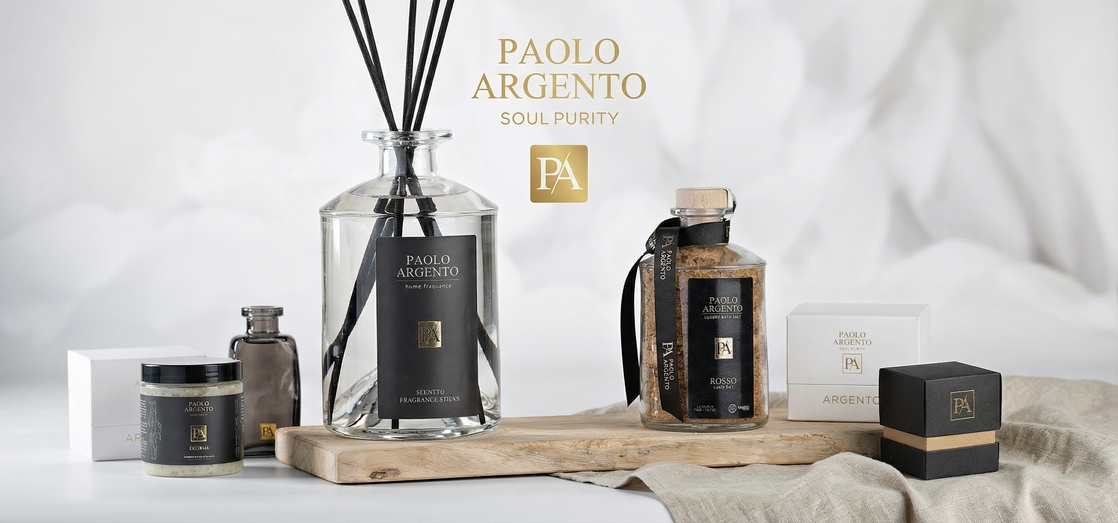
A bottle filled with scented liquid and a few simple reeds. A reed diffuser looks remarkably uncomplicated, yet it can create a continuous fragrance background for a long time – without a flame, heating or electricity. How is that possible?
A reed diffuser works through a combination of physical processes. The liquid needs to travel from the bottle through the reeds, reach their exposed surface and gradually evaporate. Along with it, volatile components of the fragrance composition are released into the surrounding air.
This is why the performance of a diffuser depends on much more than the fragrance itself. The reeds, temperature, airflow, placement, evaporation surface and conditions in a particular room can all make a difference.
It all begins inside the bottle
Inside a diffuser is a liquid that acts as a carrier for the fragrance composition. Its role is to allow fragrance components to be transported and gradually released into the surrounding environment.
When reeds are placed in the bottle, their lower sections become immersed in the liquid. A process invisible to the eye then begins – the liquid gradually travels through the internal structure of the reeds.
The diffuser does not need to pump fragrance out of the bottle. It requires neither a pump nor a source of heat. Instead, it uses the properties of the liquid and reeds together with natural evaporation.
Capillary action – invisible movement of liquid
One phenomenon that helps explain a reed diffuser is capillary action. In narrow spaces, a liquid can move as a result of interactions between the liquid and the surface of the material.
Diffuser reeds have a structure that allows liquid to travel through them. The liquid gradually moves from the immersed section towards the top, reaching the part of the reed exposed above the neck of the bottle.
In this sense, the reeds form a bridge between the liquid inside the bottle and the air in the room.
The reed itself does not create fragrance – evaporation is essential
Moving liquid upwards would not be enough to scent a room. The second important stage is evaporation.
Once the liquid reaches the exposed section of a reed, its contact with the surrounding air increases. Volatile components can enter the gas phase and disperse into the environment. This is when we begin to perceive the fragrance.
This process continues even when nobody is in the room. It is one of the fundamental differences between a reed diffuser and a candle or wax melt – a diffuser can create a continuous fragrance background without lighting or heating the product.
Why does the number of reeds matter?
Each additional reed provides another route for liquid transport and additional exposed surface from which evaporation can take place. The number of reeds can therefore influence the diffuser's performance.
Using more reeds may increase the surface available for fragrance release, but it can also cause the liquid to be consumed more quickly. Fewer reeds may create a subtler effect and slower consumption.
However, intensity cannot be predicted from the number of reeds alone. Their properties, the liquid formulation and the conditions in the room also matter.
Why does flipping the reeds make the fragrance stronger?
After some time, the fragrance may appear less noticeable. One way of temporarily increasing its intensity is to turn the reeds over.
The section previously immersed in the liquid is then directly exposed to the air. Because its surface is well saturated, evaporation can become more noticeable for a period of time.
Frequent reed flipping can, however, also increase the rate at which the diffuser liquid is consumed. Greater intensity and faster consumption are therefore connected to some extent.
Temperature changes the rate of evaporation 🌡️
A diffuser standing in the same place throughout the year may not behave identically in summer and winter. Temperature is one of the reasons.
As temperature rises, volatile components of the liquid can evaporate more quickly. A diffuser placed in a very warm location may therefore appear more intense, while its liquid level may also fall faster.
For the same reason, it is better not to place a diffuser directly beside a radiator or where it is strongly heated by sunlight. The aim is not to evaporate the liquid as quickly as possible, but to release it gradually.
Air is part of the process too
Once fragrance has been released from the reeds, it still needs to spread through the room. This is where air movement becomes important.
Natural air circulation helps carry volatile fragrance components away from the diffuser. Very strong airflow – for example beside a frequently opened window, fan or powerful ventilation outlet – can increase evaporation while also moving fragrance rapidly away from the immediate area.
Diffuser placement is therefore part of the way the product works, not simply a decorative decision.
Why does fragrance behave differently in every interior?
Two identical diffusers placed in two different homes may be perceived very differently. Room size is only one reason.
Important factors include:
– room volume and ceiling height,
– temperature,
– ventilation and how often the room is aired,
– air movement,
– diffuser placement,
– the number of reeds used,
– the character of the fragrance composition.
It is therefore unrealistic to expect one diffuser to produce an identical effect in a small bedroom and in a large open-plan living area.
Not every fragrance has the same perceived strength
Differences can also be noticed between fragrance compositions themselves. Individual fragrance materials differ in properties such as volatility, so two diffusers do not necessarily have the same character even when the same bottle and number of reeds are used.
NERO, with lemon, bergamot, ylang-ylang, sandalwood, vanilla, vetiver, amber and patchouli among its notes, has a different character from floral ROSSO, built around orchid, lily of the valley, musk, vanilla and ylang-ylang.
Fragrance intensity should therefore not be treated as a simple measure of product quality. A subtle composition may simply be designed to create a different effect from a deep woody or oriental fragrance.
Why do we sometimes stop noticing our own diffuser?
There is one more element that cannot be found in either the bottle or the reeds – our own sense of smell.
When we remain surrounded by the same fragrance for a long period, we may begin to pay less attention to it. This is related to adaptation to a continuous olfactory stimulus. Household members may therefore describe a diffuser as very subtle while someone entering the room notices it immediately.
This does not always mean that the diffuser has stopped working. Sometimes what has changed most is the way our own olfactory system responds to it.
250 ml or 700 ml – why different sizes?
The Paolo Argento® collection includes reed diffusers in 250 ml and 700 ml formats. A larger bottle primarily contains more liquid and can be a practical choice for larger interiors while also becoming a more prominent part of the room's design.
Bottle capacity itself is not a simple power control. The perceived fragrance still depends on the complete system: fragrance composition, reeds, evaporation surface, temperature, air circulation and room size.
250 ml refills are also available for selected Paolo Argento® fragrances, allowing the bottle to be refilled and a favourite fragrance to continue being used.
A simple object with fascinating physics ✨
A reed diffuser is a good example of an object that seems obvious until we look more closely at how it works. Inside one small bottle, the properties of liquids, reed structure, capillary action, evaporation, temperature and airflow all meet.
No flame or electricity is required. Liquid travels through the reeds, volatile components enter the air and natural circulation helps distribute the fragrance throughout the interior.
And that is how an understated bottle can become a continuous, discreet part of the atmosphere of a home.