


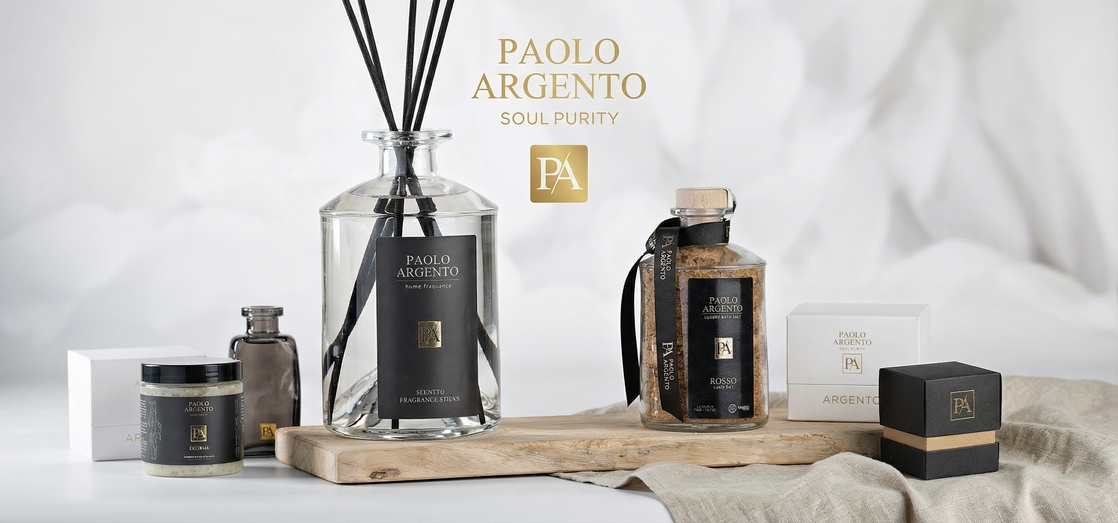
Soy wax or paraffin? For us, the choice is deliberate – this is why Paolo Argento® scented candles are made with soy wax. 🌱
When choosing a scented candle, we usually focus on fragrance, the appearance of the glass and the overall design. Yet it is worth looking deeper and asking what the candle itself is made from. The type of wax is one of the most important elements of its construction.
For decades, paraffin has been one of the most widely used materials in candle production. Today, plant-derived waxes such as soy wax are increasingly popular. This is not simply a trend. The two materials differ in their origin, properties and role in candle making.
At Paolo Argento®, we have chosen plant-derived soy wax. Why? Let us take a closer look at its advantages and at the main differences between a soy candle and a traditional paraffin candle.
Soy wax – a plant-derived material 🌿
Soy wax is produced from oil obtained from soybeans. The oil is processed to create a stable wax suitable for applications including candle making.
One of its most important advantages is that it comes from a plant-based, renewable raw material. Soybeans are an agricultural crop and can be grown again in successive production cycles.
What is paraffin wax?
Paraffin is a mixture of hydrocarbons and is a petroleum-derived material. It is obtained through processes associated with petroleum refining. Its availability, technological properties and relatively low cost helped make it one of the standard materials used by the candle industry.
Unlike soy, however, petroleum is a fossil and non-renewable resource. From a raw-material perspective, this is one of paraffin's main disadvantages for us and an important reason for choosing a plant-derived alternative.
1. Soy wax comes from a renewable raw material 🌱
This is the most fundamental advantage. Soy wax is plant-derived, while paraffin is connected to the petroleum industry.
For customers who pay attention to the origin of the materials used in everyday products, this is an important distinction. Choosing soy wax allows a fossil-derived wax to be replaced with a material based on vegetable oil.
2. A relatively low melting point
Soy waxes used in container candles generally have a relatively low melting point. This influences the way the wax behaves while the candle is burning.
Once lit, a liquid melt pool gradually develops around the wick. Heat from this pool helps release the fragrance composition. This is why the relationship between wax, fragrance and wick is so important in a well-designed scented candle.
3. Soy candles can offer a slower burn ⏳
One frequently cited advantage of soy wax is its potential for a gentle, slower burn. Its physical characteristics and melting behaviour can contribute to the way the candle consumes its wax.
Burn time is not determined by wax alone, however. Candle size, vessel diameter, wick, fragrance formulation and the way the candle is used all influence the final result.
4. Soy wax is an excellent base for scented candles 🌸
In a scented candle, wax is both the fuel for the flame and the carrier for the fragrance composition. Soy wax works particularly well in container candles and allows fragrances to be released gradually as the wax warms.
Soy wax alone does not automatically create a stronger fragrance. Performance depends on the complete formula – fragrance quality and concentration, wax, wick and vessel diameter all play an important role.
5. Plant-derived wax fits the character of a premium candle
For us, a scented candle is more than a decorative object. Its appearance and fragrance matter, but so do the materials used to create it.
This is why the plant origin of soy wax fits the Paolo Argento® approach. We combine it with carefully selected fragrance compositions, elegant glassware and correctly matched wicks to create a product in which every component has a purpose.
What about smoke and soot? 🔥
There are many myths surrounding this subject. Paraffin is a hydrocarbon-based material and incomplete candle combustion can produce soot. Studies of paraffin candles have documented soot particles, particularly under sooting or unstable burning conditions.
This does not mean that a soy candle is completely “smokeless”. Every candle with an open flame involves combustion. An excessively long wick, draughts or an unstable flame can cause smoke or soot regardless of the wax used.
Correct wick selection and care are therefore essential. Research into candle combustion confirms that wick type and dimensions influence flame size, burn rate and overall candle behaviour.
Why don't we simply call paraffin “toxic”?
Online comparisons often describe soy wax as “healthy” and paraffin as “toxic”. Such simplified claims are unnecessary when there are already clear, factual reasons to choose soy wax.
A candle is a combustion product and its performance depends on the complete system: wax, wick, fragrance composition, airflow and burning conditions. We therefore prefer to focus on facts: soy wax is plant-derived and based on a renewable resource, while paraffin is petroleum-derived and based on a non-renewable fossil resource.
Soy wax vs paraffin – key differences
– origin: soy wax is plant-derived; paraffin is petroleum-derived
– renewability: soy is renewable; petroleum is a non-renewable fossil resource
– melting behaviour: soy waxes used for candles generally operate at relatively low melting temperatures
– burn: soy wax can support a gentle, slower burn, although the complete candle design determines actual performance
– scented candles: soy wax works particularly well as a base for fragranced container candles
– paraffin: its dependence on a non-renewable petroleum resource is an important disadvantage from a raw-material perspective
– finished candle quality: regardless of wax type, wick selection, formulation and correct use remain essential
Natural variations in soy wax do not necessarily mean a defect
Soy wax can change its appearance as temperatures change. After cooling or subsequent burns, its surface may not always remain perfectly smooth. Small variations in texture can occur.
This does not necessarily indicate a defective candle. With plant waxes, correct candle performance – an even burn, stable flame and appropriate fragrance release – is more important than a perfectly uniform surface.
Soy wax + the right wick = a well-designed candle
Good wax alone is not enough. The wick must be matched to the wax, vessel diameter, fragrance composition and complete candle formulation.
Selected Paolo Argento® candles use wooden wicks. We value and recommend them based on our years of experience and extensive burn testing.
How to get the best from a soy candle 🕯️
– check the wick before each burn
– during the first burn, allow an even melt pool to develop where possible
– avoid repeatedly extinguishing the candle after only a few minutes, as very short burns can encourage tunnelling
– avoid draughts that destabilise the flame
– place the candle on a stable, heat-resistant surface
– never leave a burning candle unattended
– always follow the instructions and maximum burn time specified for the product
So why do we choose soy wax? ✨
Not because it is fashionable. We choose it primarily because it is plant-derived, based on a renewable raw material and works extremely well as the foundation of a high-quality scented candle.
Paraffin remains a widely used and relatively inexpensive industrial material, but its origin is tied to petroleum. For Paolo Argento®, choosing a plant-derived wax is more consistent with the way we want to create our products.
At the same time, experience has taught us that the words “soy wax” alone do not make a great candle. You also need a correctly selected wick, a refined formulation, a high-quality fragrance composition and repeated burn testing. Only when these elements work together do we have a candle we want to sign with the Paolo Argento® name.